
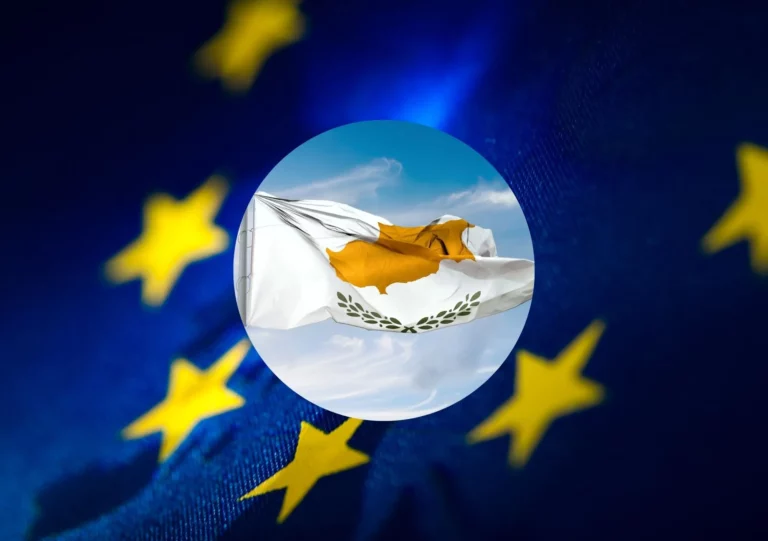
Cyprus as President of the EU Council in 2026
Since 1 January 2026, Cyprus has held the Presidency of the Council of the European Union for the second time in its history, in the framework of the rotating presidency of the EU Council. She succeeds Denmark and forms part of a Presidency trio (Ireland-Lithuania-Cyprus) to ensure the continuity of the Council's work over 18 months.
This Cyprus Presidency intervenes in a context marked by the implementation of theEU strategic agenda 2024-2029discussions on the future Multiannual Financial Framework (MFF) and geopolitical tensions in the eastern Mediterranean.
Located in the Levantine region, at the crossroads of Europe, Asia and Africa, the island is a central player in the geopolitics in the Eastern Mediterranean. With its 9 253 km2 – an area comparable to that of Ile-de-France – Cyprus is one of the smallest Member States of the European Union. Its capital, Nicosia, is home to nearly 300,000 people.
A Member State always divided
Former British colony from 1925 onwards, Cyprus gained independence on 16 August 1960. However, the United Kingdom retains two sovereign bases, Akrotiri and Dhekelia.
Since 1974, the island has remained divided following a coup d'état supported by the Greek junta and Turkish military intervention. In 1983, the northern part proclaimed the Turkish Republic of Northern Cyprus, recognized only by Ankara. The « Green line », a demilitarized zone supervised by the United Nations, still manifests this separation.
This situation weighs heavily on the EU-Turkey relationsbut also on the European Neighbourhood Policyof which Cyprus is a strategic anchor. Attempts at reunification, including the Annan Plan of 2002, have not been successful. However, the current political context suggests a possible resumption of negotiations.
Recent history and political context
Negotiations between the south and north of the island remain sensitive. The victory of the pro-European candidate Tufan Erhürman in the northern part, however, opens up new prospects for the resumption of a dialogue on reunification.
The Green Line and Geopolitical Issues
The green line illustrates the physical and symbolic division of the island. Its presence directly influences relations with Turkey and the strategic role of Cyprus in the European Neighbourhood Policy.
Cyprus and the European Union: economic integration and challenges
Cyprus joined the European Union on 1 May 2004, as a divided territory. However, the acquis communautaire only fully applies in the southern part of the island. The country adopts the euro in 2008, without integrating the Schengen area.
With six MEPs – the minimum threshold set by the Treaties – Cyprus is fully involved in European legislative work. However, it is useful to recall the distinction between European Council vs EU Council (difference) The first sets out the broad political guidelines, while the second adopts legislation with the European Parliament. The Cyprus Presidency concerns the EU Council.
A highly tertiarized economy
The Cypriot economy is mainly based on services (75 per cent of jobs) and tourism, with nearly six million visitors in 2024. After being one of the most prosperous new Member States, the country was hit hard by the 2008 financial crisis, leading to intervention by the European Central Bank and the IMF.
GDP and impact on the EU
Today, its GDP per capita (€35,900) remains below the European average (€38,100) and represents about 0.2% of total EU GDP.
What is the programme of the Cyprus Presidency of the EU Council in 2026?
The Cyprus Presidency programme the currency: « An autonomous Union. Open to the world ».
In this context, Cyprus intends to strengthen theEU strategic autonomy, including through:
- Accelerated work on European defence;
- continued support for Ukraine;
- enhancing maritime security in the Mediterranean;
- consolidation of the European energy sovereignty.
Economically, the Presidency focuses on:
- regulatory simplification for SMEs;
- deepening the Capital Markets Union;
- innovation and digital sovereignty;
- the preparation of the future Multiannual Financial Framework (MFF) 2028-2034.
Migration issues also occupy an important place, including the migration management in the Mediterranean and implementation of the Asylum Pact. In view of its geographical position, Cyprus is directly concerned by the EU border management and discussions onenlargement of the European Union.
Finally, the Cyprus Presidency intends to strengthen dialogue with neighbouring countries within the framework of the European Neighbourhood Policyand deepening relations with the countries of the South and the Gulf. This dynamic forms part of a broader reflection on the EU dialogue with third countries (India, Gulf, Africa).
A fragile start to the presidency
The launch of the Presidency was marked by the « Video Gate », a scandal related to a video broadcast on social network X. This case, involving accusations of circumvention of political financing rules, raised questions about institutional transparency.
Beyond this controversy, Cyprus will have to demonstrate its ability to fully exercise the role of the Presidency in the EU Councilin particular by presiding over the General Affairs Councilby organising ministerial meetings and facilitating legislative compromises between Member States and the European Parliament.
What is the gold passport scandal?
Between 2007 and 2020, Cyprus introduced a programme of « citizenship by investment »allowing foreign investors to obtain Cypriot citizenship, and thus a passport from the European Union, against major investments in the country.
This scheme was officially adopted suspended in 2020 After media revelations. For more information, see our article on European citizenship.
Why is Cyprus a still divided state?
Since 1974Cyprus is divided following a coup d'état supported by the Greek junta and a military intervention by Turkey. The northern part proclaimed in 1983 the Turkish Republic of Northern Cyprus, recognized only by Ankara. The island remains separated by the « Green line »under UN supervision.
What is Cyprus' role in the EU Council Presidency?
Cyprus organise and chairs the meetings between Member States and facilitate compromises legislation. His presidency focused on theEuropean strategic autonomysupport for Ukraine, economic competitiveness and ecological transition.

