
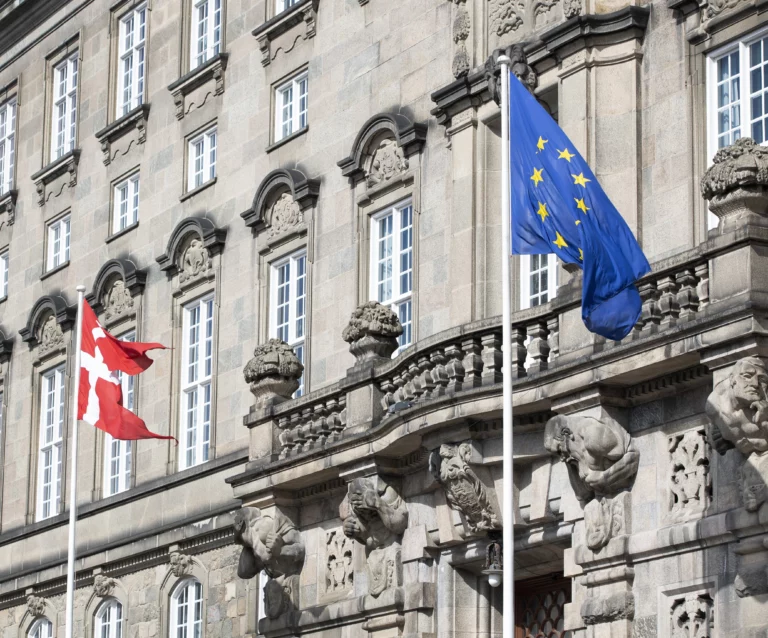
Despite its wealth and its great history, Denmark remains a little known country in our European Union. With its 5.96 million inhabitants (Eurostat, 2024), it remains a "small" EU country, with a population comparable to that of Finland, and almost twice as small as that of its Swedish neighbour. Its capital, Copenhagen, occupies a major place, so that one in five Danes lives in its agglomeration.
In economic terms, it is undoubtedly one of the countries in the richest in Europe (3rd highest GDP per capita) and one of the less unequal (0.27 on the Gini index in 2020). Culturally, Denmark is very close to its Scandinavian neighbours, Sweden and Finland. Finally, it is common to forget that the territories of the Faroe Islands and Greenland are also part of the Kingdom of Denmark. However, these two territories have a special status of autonomy and are not part of the European Union.
Denmark and the European Union: a tumultuous history
Although Denmark is fully committed to the European project, it has sometimes been distrustful of EU policies.
Between enthusiasm and distrust of the European Union
Although Denmark was not one of the six founding countries of the European UnionHis arrival in the organization dates back several decades. In fact, Danes join the EU in 1973, alongside the United Kingdom and Ireland, forming the first enlargement. However, this early accession is not synonymous with pro-European enthusiasm without limits; Denmark has very often been inclined to distrust, making its history with Europe at least energized. This mistrust is due in particular to the fear of losing its independence; Denmark being a small country,fear of being captured by the great powers" explains, according to researcher Henrik Larsen, sound lack of European commitment.
The greatest illustration of this Euroscepticism took place in 1992 with the Maastricht Treaty than the Danes. reject by referendum. A year later Denmark, like the United Kingdom, refused to participate in the euro area. Still today, the country keeps its own currency, the Danish krone, thanks to this "opt-out" negotiated through the Edinburgh agreements. However, Denmark agrees with the idea of free movement of persons in the EU, which is why it is member of the Schengen area. Finally, in December 2015, a new European referendum was rejected by the Danes, who refused to increase European defence cooperation by 53%.
A sure commitment and common goals
In spite of these expressions of reluctance, Denmark maintains strong ties with the European Union, particularly in view of the values they share, such as freedom and freedom. solidarity. Very involved in the fight against inequalities and the social supportDenmark promotes a collective and collaborative society, as does the EU. This shared vision is complemented by common strategic and policy objectives, which reinforce the importance of collaboration.
On the one hand, Denmark remains very concerned about the environmental issues 44% of its energy comes from renewable sources, placing it third among European countries (Eurostat, 2023). It therefore shares a strong objective with the EU, which seeks through the Green Compact to Reduce Emissions to Achieve Carbon Neutrality by 2050.
On the other hand, the question of defence has become a central source of concern for the Danes, since the Russian invasion in Ukraine. An illustration of this fear, Denmark has completely changed its shoulder rifle to 2022, by integrating the EU Common Security and Defence Policy (CSDP). This decision, adopted by 67% of Danes by referendum, goes back to the initial refusal of 1992 and shows a radical shift towards a common European defence. Even more recently, in the context of the United States' disengagement in Europe, Denmark has announced its intention to increase its defence spending massively by the end of 2025.
Danish Presidency of the EU Council: for a "safer, greener and more competitive" Europe
It is in this particular context, but also in favour of closer ties, that Denmark has begun its 6 months as head of the Council of the European Union. This institution, which represents the governments of the Member States, meets in particular to develop the foreign and security policyadopt the budget and to conclude international agreements on behalf of the EU. The country chairing this Council is not elected: it changes every six months, so that each Member State can lead the EU Council within 12 years. And he does not hold the presidency alone, since he is supported by the next two countries according to the rotating presidency. Currently, Denmark forms this group, which is called « trio »with Cyprus and Ireland.
For its presidency, Denmark has set its priorities through a strong slogan: « For a Europe safer, greener and more competitive ». In concrete terms, this will result in implementation of the plan Readiness 2030, validated last March. As regards the environment, Denmark will lead the negotiations on the European Green Pact, binding targets by 2040 to reduce greenhouse gas emissions, while maintaining a competitiveness for Europe. Moreover, the country wants to fight organised crime, and wants to pave the way for a new European asylum system.
Thus, there is no doubt that the coming months of the Danish presidency will be decisive for Europe. In addition, the Presidency of the EU Council will also have a strong impact on the national political life of the Danes, who will be called to the polls in 2026 for the parliamentary elections.
How is inequality measured in European countries?
To compare the concept of inequality between different countries, the main use is toGini Index. This indicator (between 0 and 1) measures the level of income inequality between the inhabitants of a country The closer it is, the greater the inequality.
According to this indicator, Slovakia is the European country with the least inequality (0.21, according to Statista in 2022). France is just above the European average (0.29), while Bulgaria is the most unequal in the EU (0.38).
Have Greenland and the Faroe Islands been part of the European Union?
Despite their connection to Denmark, the Faroe Islands have never been part of the European Union, particularly because of the common European fisheries policy. Conversely, Greenland has been part of the EU with Denmark, but Ia left in 1985 12 years after Danish accession.
By whom is Denmark headed?
Denmark Constitutional monarchyBut his king, Frederik X, has a function strictly symbolic. In practice, the country is led by the Prime Minister Mette Frederiksen, since 2019. Born of the Social Democracy Party (SD), with which she won the general elections of 2022, she will again have to face the polls in 2026.

