
5 May 1949: Creation of the Council of Europe, beginning of the history of the European Union
At the end of World War II, European leaders sought to build security so as not to relive the hell of war. They then founded the Council of Europe with a view to strengthening the democracy and respect for Human Rights. The ten founding countries (Belgium, Denmark, France, Ireland, Italy, Luxembourg, the Netherlands, Norway, Sweden and the United Kingdom) created the European Convention on Human Rightswhich aims to protect the rights and fundamental freedoms of all Europeans. It is to ensure its respect that the Council of Europe has created the European Court of Human Rights10 years later.
Still in place today, the Council of Europe is the first stone laid in the direction of a gathering of European states.
9 May 1950: Declaration by Robert Schuman
In this post-war context, European leaders continue to strengthen their ties. In this sense, French Foreign Minister Robert Schuman proposes an ambitious idea: the convergence of European economic interests, via the joint coal and steel production, the main industries of war. A year later, the ECSC (European Coal and Steel Community) was established thanks to the agreement between West Germany, France, Italy and the Benelux countries (Belgium, the Netherlands and Luxembourg).
Today, this declaration is considered to befounding act European Union.
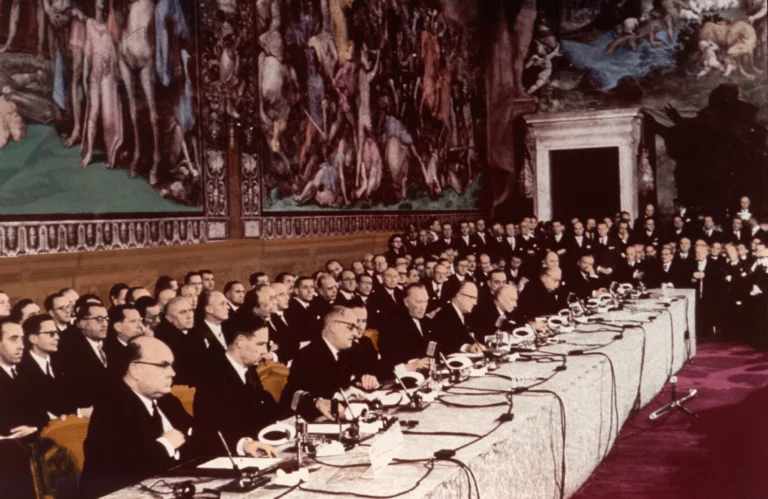
25 March 1957: signatures of the Treaties of Rome
Germany, Belgium, France, Luxembourg, Italy and the Netherlands sign two treaties which will enter into force in 1958. The first establishes the EEC (European Economic Community), which aims to create a common market between European countries by increasing economic ties between Member States. On the other hand, the EEC is leading to the creation of a European Parliamentary Assembly, whose members come from the national parliaments.
A second treaty, named Euratom, is also signed. Consolidated in 2012It aims to form a common nuclear industry, bringing these European countries even closer together.
1 January 1973 : First enlargement of the Communities
A few years later, several European countries want to join the three Communities (ECSC, EEC and Euratom). However, Charles De Gaulle's France, fearing a weakening of the European Communities, twice refused to apply for membership of a United Kingdom once again turned towards Europe. Finally, after Georges Pompidou came to power, a first enlargement took place in 1973. Three new countries join the Communities: United Kingdom, Denmark andIreland.
Eight years later, Greece will also be part of the organisation, which brings together 10 countries.
10 June 1979: First European Parliament election
Four years earlier in Paris, European leaders created the European Council, which allows all Heads of State to meet once a year. In addition, the functioning of the European Parliament is changed. While they were previously appointed, it is decided that MEPs will now be elected by direct universal suffragein all Member States. 60% of European voters take part in the first elections in 1979, where Simone Veil, French Minister of Health, is chosen to become the First President of the European Parliament.
For more information on the various European institutions, see page of the European institutions.
14 June 1985: signature of the Schengen Agreement
As early as 1980, the idea of a freedom of movement people between France, Germany and the Benelux countries are emerging. It is endorsed with this agreement, and is reflected in 1995 with the implementation of theSchengen area : an area without frontiers within which people are free to move, without passports or customs controls. The space is named with reference to the Luxembourg City of Schengen, where the agreement was signed.
Year after year, the other EEC countries join the Schengen area; It now has 29 states, some of which are not even EU members.
7 January 1992: signing of the Maastricht Treaty
This treaty marks the first appearance of the term "European Union" The EU is then intended to consolidate the three European pillars Community, CFSP (Common Foreign and Security Policy) and police and judicial cooperation. For the first time, the European alliance goes beyond the mere economic interest, and anchors in a Political vocation.
Finally, the Treaty lays the foundations for a common currency…
1 January 2002: Euro launch
After a decade of work and preparation, the first coins and the first banknotes are put into circulation in 12 Member States European Union. These nations enter into the Euro area, which includes all countries using the same currency ; Today, there are 20 of them. Little by little, the euro is imposing itself as one of the most used currencies in the world, and is distinguished by its stability.
Beyond sharing common values and ideals, Europeans thus acquire a new symbol of union, concrete and material:euro.
1 May 2004: EU enlargement
Since 1981 and "the Ten", the European Union has ceased to grow. In 1986, following the more open falls of dictators Franco and Salazar, Spain and Portugal joined the EU. In 1995, it was the turn of Austria, Finland and Sweden, while Norway and Switzerland reject accession by referendum. On 1 May 2004, an unprecedented enlargement took place: 10 countries join the European Union: Cyprus, Malta, Czech Republic, Estonia, Poland, Latvia, Lithuania, Hungary, Slovenia and Slovakia.
This enlargement is due in particular to the break-up of the Eastern Bloc.. In 2007, two new countries, Romania and Bulgaria, formed "Europe of 27”.
1 February 2020: UK leaves the European Union
On 23 June 2016, the Brexit (Treatment of "British" and "Exit") is subject to the decision of the British citizens following a mistrust towards the EU, in particular related to the migration issue. During this referendum, 52 % Voters vote in favour of exit from the European Union. Four years later, the United Kingdom, which historically has never been very Euro-convinced, became the first State in the history of the European Union to leave, thanks to the conditions of exit imposed by the Treaty of Lisbon in 2009. This is the latest movement within the EU, which is still composed of 27 Member States Croatia joined the EU in 2013.
However, some countries remain candidates for accession, including several Balkan countries, Turkey or more recently Ukraine; accessions that would help to continue the course of European Union history.
Shared competencies
In these areas, the EU and the Member States can adopt legislation.
Member States can only do so if the EU has decided not to do so or has not yet proposed legislation.
- The internal market
- Social policy, for the specific aspects defined in the Treaty exclusively
- Economic, social and territorial cohesion
- Agriculture and fisheries
- Environment
- Consumer protection
- Transport
- Trans-European networks
- Energy
- The area of freedom, security and justice
- Common Public Health Safety Issues
- Research, technological development and space
- Development cooperation and humanitarian aid
Support skills
These areas of competence remain the responsibility of the Member States, but the EU can support, coordinate or complement their action, without being able to legislate in these areas.
- Protection and improvement of human health
- Industry
- Culture
- Tourism
- Education, vocational training, youth and sport
- Civil protection
- Administrative cooperation
Competences « special »
In some areas, the EU can play a special role or go beyond what is provided for in the Treaties.
- Coordination of economic and employment policies
- The definition and implementation of the common foreign and security policy
- The «flexibility clause» which under strict conditions allows the EU to intervene outside its normal areas of responsibility
Who are the 6 founding countries of the European Union?
The founding act of the European Union as we know it today remains the establishment of the ECSC (European Coal and Steel Community) in 1951. The six founding countries of the EU are the six signatory countries of the ECSC: Germany, France, Italy, Belgium, the Netherlands and Luxembourg.
Who are the "founding fathers" of the European Union?
In these areas, the EU and the Member States can adopt legislation.
Member States can only do so if the EU has decided not to do so or has not yet proposed legislation.
- The internal market
- Social policy, for the specific aspects defined in the Treaty exclusively
- Economic, social and territorial cohesion
- Agriculture and fisheries
- Environment
- Consumer protection
- Transport
- Trans-European networks
- Energy
- The area of freedom, security and justice
- Common Public Health Safety Issues
- Research, technological development and space
- Development cooperation and humanitarian aid
Have some countries rejected the European Union?
Beyond the UK that emerged, several European countries have already refused to join the EU. This is particularly the case for Switzerland, whose accession to the EU was rejected by referendum in 1992. Norwegians also refused twice by referendum entry into the EU in 1972 and then in 1994. Finally, in 2015, Iceland abandoned an application for membership six years earlier, mainly due to disagreements on the issue of fisheries.

