
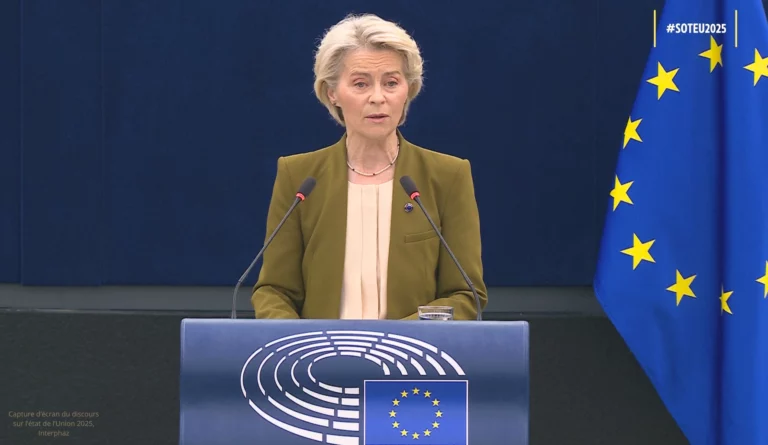
On 10 September 2025, Ursula von der Leyen delivered in Strasbourg his fifth speech on the state of the Union 2025 (SOTEU), the first of its second term at the head of the European Commission. For 90 minutes, the President addressed MEPs, the European Parliament, the European Council and the Commission in three languages — English, French and German — with simultaneous translation into the 24 official languages of the European Union.
Established in 2010 by the Treaty of Lisbon, the SOTEU has become an essential event for the European political re-entry. It allows preparing the annual review and presenting the European priorities 2025 while opening the debate with representatives all parliamentary groups.
The 2025 speech is part of a particularly tense international context: war in Ukraine, recomposition of geopolitical alliances, trade tensions Global internal democratic challenges the Union. In the face of this situation, von der Leyen put his intervention under the sign of theEuropean unit, presenting a series of initiatives to build a stronger, safer and more prosperous Europe, in line with ongoing European reforms.
Several topics were discussed — European security and defence, enlargement, ecological transition Europe and innovation and digital EU, migration and natural disasters, war and the humanitarian crisis in Gaza — But three main themes emerge: Ukraine, relations Transatlantic and protection of the democracy and social networks.
Europe's support for Ukraine at the heart of the speech
One of the strongest moments of the SOTEU 2025 was devoted to the war in Ukraine and to the European defence. Ursula von der Leyen told the story of Sasha, a boy abducted by Russian forces, and her grandmother, Liudmyla, who brought him back to Ukraine. Both were present in the Chamber, symbolizing the resilience of the Ukrainian people and European solidarity.
The President announced the organisation of a summit of the international coalition Ukraine for the return of Ukrainian children deported. « All Ukrainian children abducted must be returned! » She said that Ukraine's freedom is also Europe's freedom.
A war that intensifyes, a Europe of solidarity
Von der Leyen denounced the Russian attacks:
- massive missile and drone fire,
- murderous bombardments in Donetsk against civilians,
- violation of Polish airspace by Russian drones the night before his speech.
It reaffirmed the Union's total solidarity with Poland and stressed the need for United and credible defence Europe.
New sanctions and innovative financing
A 19th package of sanctions is being prepared, with priorities:
- faster end of Russian fossil fuel imports,
- fight against the ghost fleet that circumvents sanctions,
- more monitoring of trade via third countries.
On the financing of support for Ukraine, Von der Leyen proposeduse income generated by frozen Russian assets to grant Kiev a repair loan. « We will not touch the assets themselves »She added that Ukraine will only repay this loan once Russia has paid for the war damage.
A "Quality Military Advantage"
To enable Ukraine to maintain its technological advance against the Russian army, the Commission will launch a new programme called Qualitative military advantage (Qualitative Military Edge). It will support investments in Ukrainian military capabilities, particularly in drones.
Von der Leyen recalled that while Ukraine had no drone before the war, these aircraft now cause more than two thirds of Russian equipment losses. One European drone alliance will be set up to transform this Ukrainian ingenuity into mass industrial production, with an additional financial support of €6 billion.
Towards a Europe of defence
The President expanded her remarks to include: Security Council Even if the war were to cease, the Russian war economy will continue. LEurope must so investment in its own defence, complementary to NATO but with independent strategic means.
Among the projects announced:
- the plan “Preparation for 2030”, mobilising up to EUR 800 billion in investment,
- the programme SAFE, with EUR 150 billion for joint purchases,
- strengthening the eastern flank of Europe, from the Baltic to the Black Sea, through the initiative Eastern Flank Watch,
- the implementation of real-time spatial monitoring and the construction of Drone wall Europe East.
A firm message concludes this chapter: « Europe will defend every square inch of its territory. »
High surveillance transatlantic relations
After having devoted much of his speech to the war in Ukraine and to defence, Ursula von der Leyen turned to another essential pillar for the Union: its relations with the United States. The trade agreement concluded with Washington at the end of July 2025 marked a turning point and generated many comments to the European Parliamentsome very critical.
A vital economic partnership
Von der Leyen recalled: « Our trade relations with the United States are our most important relations. We export more than EUR 500 billion in goods to this country every year. Millions of jobs depend on it. »
The Transatlantic Partnership remains the most important bilateral relationship in the world: in 2024, trade in goods and services betweenEuropean Union and the United States reached EUR 1 600 billion, or more than EUR 4.2 billion each day. Cross-investment amounts to €5,300 billion. These figures show how much savings are integrated, with highly intertwined value chains and many European SMEs directly dependent on the US market.
A controversial but stabilizing agreement
The agreement concluded on 27 July 2025 lays down a 15 % overall ceiling for US customs duties on European goods. Von der Leyen defended this compromise: « As President of the Commission, I'll never play with the job or the livelihoods of citizens. »
This ceiling applies to the majority of EU exports, particularly in the strategic sectors: automotive, aeronautics, pharmaceuticals. The agreement does not eliminate customs duties but offers welcome predictability and guarantees a benefit to European companies.
Detailed content of the agreement
- Limit of 15% on almost all European exports, including automobiles (up to 25% before).
- Reduction rights over certain products strategic objectives : aircraft, industrial parts, generic medicines.
- Protection of the sectors sensitive Steel, aluminum, copper.
- Estimated annual savings of €5 billion for European importers and consumers.
- Limited opening from the European market to non-sensitive US agricultural exports for a volume of €7.5 billion.
- Secure access to US energy sources: €700 billion in liquefied natural gas, oil and nuclear over three years, and €40 billion in AI chips.
A Europe that retains its autonomy
Von der Leyen stressed: « Whether it is environmental or digital regulation, we set our own standards. Europe will always decide for itself. » This message aims to reassure the Union's regulatory sovereignty. Sensitive agriculture, including beef and poultry, remains protected.
A strategic choice in the face of global rivalries
In her speech, the President put the agreement in a broader geopolitical context: the rapid evolution of the global landscape, China approaching Russia and North Korea, and the need for Europe to diversify its trade partnerships. Negotiations are already under way with Mexico, Mercosur and India. These efforts are part of the European post-pandemic strategy, aimed at strengthening supply chains and providing European companies with new opportunities.
A balance between stability and independence
In conclusion, Ursula von der Leyen recalled that Europe must Stay one independent actor, able to choose its rules and build its European Economic Security on an extended basis.
Freedom of the press, disinformation and social networks
After insisting on defence and transatlantic relations, Ursula von der Leyen put his speech back under the sign of fundamental freedoms, including the freedom to vote, express and inform.
A central issue for European independence
The rise in Disinformation threatens citizens' confidence and democracy. The Commission proposes the creation of a European Centre for Democratic Resilience to monitor, detect and counter information manipulations. This initiative complements the work of the Decoders of Europe.
Support independent media and fill the gaps « Information deserts »
Von der Leyen warned against the disappearance of local newspapers and traditional media, creating real Information deserts. The media resilience Support:
- independent journalism,
- Media education,
- investment in local media,
- European funding for the press.
Social media: a freedom that can become a vulnerability
Social networks expose children to dangers such as online harassment, adult content, promotion of self-harm and dependence on algorithms. Von der Leyen proposes a age limitation to protect young people, such as existing restrictions on alcohol or tobacco.
Towards a Europe that protects its citizens and democracy
The fight against disinformation and the regulation of social media is part of a broader objective: to protect citizens and the public. defending democracy. By placing the free press and digital security at the heart of the discourse, Ursula von der Leyen showed that Europe's independence is also based on protecting public space, beyond the European Security and Defence and EU budget.
In conclusion, the SOTEU 2025 confirmed the desire of Ursula von der Leyen to make his second term a time of consolidation for theEuropean Union. Defend Europe on the international stage, preserve its commercial interests via the Transatlantic Partnership, invest in European defencesupport Ukraine and strengthen democracy through the free press and the fight against EU disinformation These are the priorities highlighted.
The speech on the State of the Union 2025 is a call for unity, in the face of multiple crises, and is a decisive step in preparing the Union for the security, economic and democratic challenges of the coming years.
How could SOTEU 2025 influence the future legislative decisions of the European Union?
The speech by the President of the European Commission highlights the European priorities 2025 and European reformsHowever, it remains to be seen how these guidelines will be translated into concrete legislative initiatives. The role of European Parliament and European Council will be instrumental in transforming these proposals into laws.
What are the challenges for Europe to maintain a balanced transatlantic partnership in the face of the rise of new economic powers?
The speech emphasises the importance of relations with the United States, but it does not explore fully how toEuropean Union could manage the growing competition from China, India or other global players while preserving its European Economic Security.
How can Europe strengthen the fight against EU disinformation while respecting freedom of expression?
The speech refers to the creation of a European Centre for Democratic Resilience and programmes media resilience, but the exact modalities for balancing protection of citizens and freedom to inform remain an open question.
What are the means to ensure the sustainable industrial production of drones within the framework of the Qualitative Military Edge programme and the European drone alliance?
The speech evokes the Military investment for support Ukraine, but does not detail how Europe will be able to develop this technology on a large scale while respecting the environmental standards and Security.

