
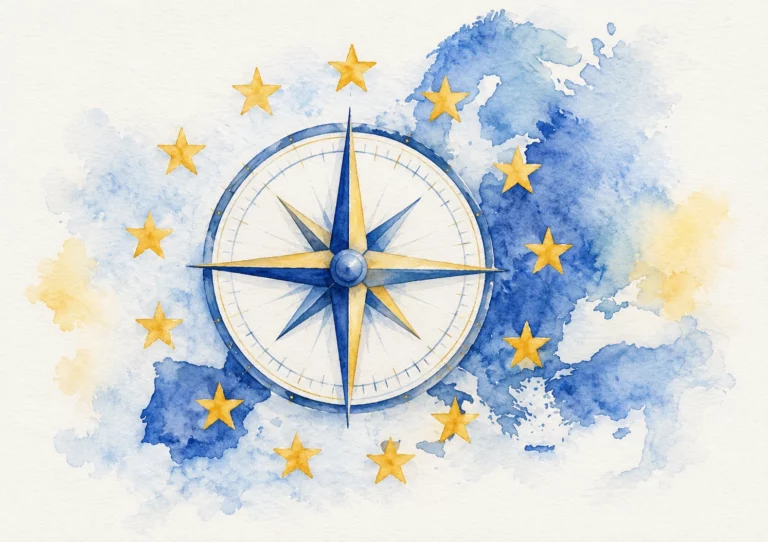
The Report on the European Union's activity in 2025 marks a paradigm shift: ecological transition is no longer just an environmental policy, it becomes a lever of competitiveness, resilience and innovation.
For many years, discussions on environmental transition have often been presented as an arbitration between environmental protection and economic development. On the one hand, the imperatives of competitiveness and growth; on the other, the fight against climate change, the protection of biodiversity or the reduction of pollution.
The Report on the activity of the European Union in 2025 evidence of a profound evolution of this vision. The European Union no longer presents these issues as competing objectives, but as the components of the same strategy. The European competitiveness of tomorrow would now rest on ulow-carbon economy, plus innovative, plus circular and more respect for natural resources.
This approach does not involve abandoning Europe's economic ambitions. On the contrary, it is based on the idea that the ecological transition is today an essential condition for prosperity, resilience and strategic autonomy of the continent.
A new vision of European competitiveness
The report highlights a change in vocabulary that reflects a change in strategy. Where European policies were mainly associated with Green Pact (Green Deal), including Border Carbon Adjustment Mechanism (BCM), emphasis is now on competitiveness, innovation and economic sovereignty. In January 2025, the European Commission presented its « compass for competitiveness« , a roadmap that will guide EU work in this area for the next five years.
The stated objective is clear: to enable Europe to remain a great economic power while continuing its climate and environmental transition.
This evolution responds to several simultaneous challenges: increased international competition, dependence on certain raw materials, rising energy costs, accelerating climate change and continuing ecosystem degradation.
From this perspective, the ecological transition is no longer presented as a cost that should be borne, but as an investment designed to strengthen Europe's capacity to produce, innovate and create value over the long term.
An ecological transition for the economy
The report stresses in particular that climate, energy and industrial policies must now be thought together.
This approach is reflected in the desire to:
- accelerate industrial innovation;
- developing clean technologies;
- strengthening the circular economy;
- secure supply of critical raw materials;
- promote cleaner and more affordable energy.
All these levers pursue a common objective: to make the European economy more competitive while reducing its environmental footprint.
Climate, biodiversity and pollution: the same equation
One of the most interesting lessons of the report is that it no longer deals separately with climate, biodiversity and pollution.
These three issues are presented as a triple environmental crisis which directly affects European companies, but also their economy.
This reading reflects an important development: the degradation of natural environments is no longer considered merely an environmental problem; It also becomes an economic risk factor.
Healthy ecosystems support economic activity
Without developing in detail the concept of ecosystem services, the report implicitly recalls that the quality of natural resources is a condition for many economic activities.
Good quality water, functional soils, resilient natural spaces and environments capable of mitigating some of the effects of climate change all contribute to the proper functioning of the territories.
The protection of biodiversity This is an investment in economic resilience as well as in the preservation of natural heritage.
The circular economy changes in size
Another significant development is that the circular economy is no longer presented as a means of reducing waste.
She becomes a strategic tool to strengthen the economic security of the European Union.
In the context of international tensions and dependence on certain resources, better recycling, reuse and valorisation of raw materials is also a competitive issue.
A response to the challenges of sovereignty
The report highlights several complementary areas:
- limiting dependence on critical raw materials;
- secure supply chains;
- fostering industrial innovation;
- strengthening the resilience of European companies.
The circular economy thus contributes to both the Union's environmental and industrial objectives.
Environmental transition becomes an industrial policy
One of the most significant developments in the report is undoubtedly the emphasis placed on Clean Industry Pact (Clean Industrial Deal).
This initiative illustrates the willingness to bring together policies that have so far been often addressed separately: industry, energy, innovation, climate, raw materials, skills and competitiveness.
The European Union now considers that decarbonisation of the economy can become a driving force for innovation, job creation and industrial development.
The European Competitiveness Fund: a tool to match ambitions?
The idea would be to explain that the Commission is now proposing that several financial instruments should be grouped around a European Competitiveness Fund, to accelerate strategic investments.
However, this approach is under discussion. In an analysis published in October 2025IDDRI questions the real capacity of the future European Competitiveness Fund to simultaneously support the decarbonisation of the economy, the ecological transition and the strengthening of European competitiveness. In particular, the Institute stresses thateffectiveness of the system will depend on its level of fundingits governance and its ability to direct investment to the most strategic sectors.
A more comprehensive strategy
This new approach goes far beyond environmental policies alone.
It aims to build an economy capable of:
- to produce more on European territory;
- developing technologies for the future;
- strengthening its strategic autonomy;
- reduce its greenhouse gas emissions;
- while protecting natural resources better.
The ecological transition thus appears to be a real long-term economic project.
A development which also concerns enterprises and territories
Although the report focuses on the European institutions, its message goes far beyond public policy.
Enterprises, local and regional authorities and development actors are directly affected by this development.
Development projects will increasingly need to integrate climate, biodiversity, pollution, energy and resource use issues.
It is no longer simply a matter of meeting regulatory requirements, but of anticipating the economic changes that will accompany the ecological transition.
Conclusion
The Report on the activity of the European Union in 2025 reflects a paradigm shift.
Instead of opposing economic growth, competitiveness and environmental protection, the European Union is now seeking to demonstrate that they are interdependent.
In this vision, biodiversity, the fight against climate change, pollution reduction, the circular economy and industrial innovation are no longer separate policies. They participate in the same strategy to build a more resilient Europe, plus autonomous and more competitive.
While this approach will have to be translated into concrete action in the years to come, it is already an important development in the way in which Europe envisages its economic development.
Why are we talking today about « sustainable competitiveness » ?
Sustainable competitiveness refers to the capacity of an economy to creating value while preserving natural resourcesreducing its greenhouse gas emissions and strengthening its resilience to crises. For the European Union, this approach aims to reconcile innovation, economic sovereignty and ecological transition in order to ensure long-term prosperity.
What is the « Compass for competitiveness » the European Commission?
Presented in 2025, the Compass for competitiveness is a strategic roadmap of the European Commission. It identifies the priorities which should enable the Union to strengthening its competitiveness in the coming years, in particular by stimulating innovation, accelerating the decarbonisation of industry, securing access to critical raw materials and simplifying the regulatory framework.
It is based in particular on the recommendations made by Mario Draghi and Enrico Letta.
Why is biodiversity becoming an economic issue for businesses?
Enterprises depend directly on resources natural resources and ecosystem services: water availability, soil quality, pollination, regulation of natural hazards and adaptation to climate change.
Biodiversity degradation can fragile supply chainsincrease certain costs and limit the resilience of economic activities. This is why European policies are now integrating biodiversity as a a competitive factor and not just as an environmental issue.

