
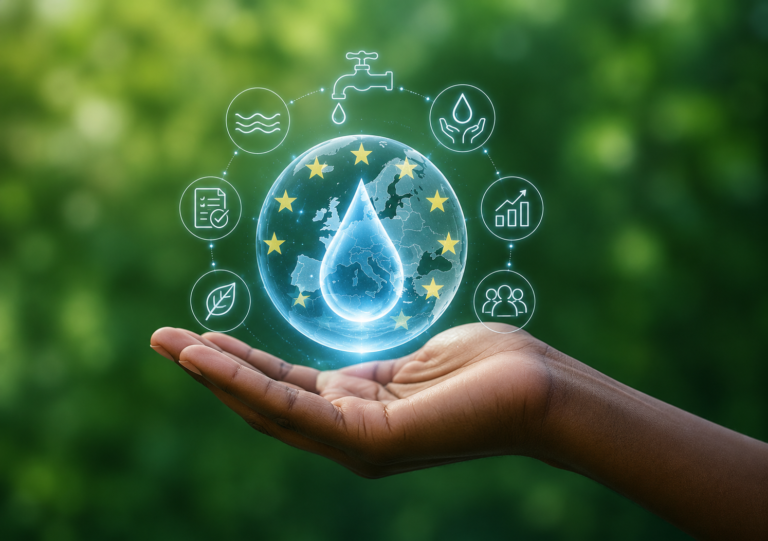
Water is indispensable for life. It is essential to our health, agriculture, industry, the functioning of ecosystems and contributes to climate regulation.
However, this resource is now increasingly threatened by the Climate Changepollution, droughts and floods.
Europe is the fastest warming continent in the world. These developments weaken European water resources and exacerbate the inequalities access to quality water. In the face of these challenges, the European Union considers Water as a good and recalls that access to clean and affordable water is a Human Rights. This is why it has for several decades been setting up a common policy to protect this resource and ensure its access to all.
Why is the European Union pursuing a water policy?
Water knows no boundaries. Rivers cross several countries, groundwaters can be shared between states and the seas connect the whole continent. Pollution or mismanagement in a country can therefore have consequences far beyond its borders.
In order to respond to these challenges, European countries have developed a European water governance and common rules to protect water resources sustainably. This sustainable water resource management to prevent droughts, floods and water shortages in Europe, while strengthening the security of water supply.
The European Water Resilience Strategy in Europe, presented in 2025, This will be achieved by placing water management among the main political priorities of the European Union. This strategy aims in particular to strengthen the resilience of water systems to the effects of climate change.
The Directive-water framework: the basis of European policy
Adopted in 2000, the Water Framework Directive constitutes the The main reference text of European water policy. It sets a common objective for all Member States: sustainable protection of surface water, groundwater and aquatic ecosystems.
This Directive constitutes the framework for the protection of water resources in Europe. It serves as a basis for many other European policies, including drinking water, bathing water, nitrates, floods and urban waste water.
How does the European Union protect water resources?
Ensuring quality drinking water
The European Union common standards so that everyone can access Safe drinking water. The Drinking Water Directive reinforces the Health checksimproves information for citizens and promotes better access to water.
This policy helps to ensure access to drinking water in Europe and responds in particular to theEuropean Citizens' Initiative Right2Water, which demanded recognition of access to water as a fundamental right.
Preserving aquatic environments
European policy protects rivers, lakes, groundwaters and the marine environment from the different forms of pollution. It also acts against nitrates from agriculture in order to preserve European aquatic ecosystems and to ensure good quality water for citizens, Agriculture and Economic activities.
This action contributes to the fight against water pollution in Europe and preservation of the water cycle, essential to the proper functioning of natural environments.
Reducing pollution and improving wastewater management
The European Union also oversees the urban waste water treatment to limit pollutant releases to the environment. It also encourages reuse of treated wastewater, particularly for agricultural irrigation, in order to save water resources and better cope with periods of drought.
This approach is part of a logic of circular water economy and aims to encourage more responsible use of available resources.
A policy adapted to the challenges of tomorrow
Addressing droughts and floods
Drought episodes, water shortages and floods are increasingly common in Europe. Member States must therefore identify areas at risk, setting up Management plans and develop measures to protect people, the environment and economic activities.
Building resilience to climate change
Beyond crisis management, the European Union wants to build a more resilient system, capable of resisting, adapting and recovering from the effects of climate change.
This approach is based in particular on the better water cycle protection1 sustainable use of resources and development of real water security in Europe.
Water, an issue beyond European borders
Water protection does not stop at the borders of the European Union. Through her World Water ProgrammeThe European Union supports access to safe drinking water and sanitation, the protection of aquatic ecosystems, international cooperation and more sustainable water management.
By 2050, the European Union wishes to guarantee the Water safety for allstrengthen resilience to water stress, protect ecosystems and promote more responsible use of this indispensable resource.
As he said Jessika Roswall on the occasion World Water Day 2026 : « Where water flows, equality grows. » This formula emphasises that access to safe and resilient water constitutes a Health lever, of prosperity andequal opportunitieswhile recalling that unequal access to water disproportionately affects women and girls.
The issue of water is also reflected at the territorial level, where its management calls for cross-border administrative boundaries and cross-references, knowledge and experience. It is in this perspective that VivaCités Hauts-de-France, in partnership withLille Development and Urban Development Agencyorganise the 4th edition of the Mapping Biennale on water without frontiers.
From 28 September to 3 October 2026, the Biennale will invest the territory of the Eurométropole Lille-Kortrijk-Tournai through a program combining scientific, sensitive, interactive and participatory cartography. These approaches will be complemented by a variety of formats and tools that promote collective intelligence, knowledge sharing and territorial co-construction. A way to explore water-related issues from different angles and to bring together new ways of thinking and acting across borders.
What is European water policy?
European water policy refers to all the rules, strategies and actions put in place by the European Union to protect water resources, ensure their quality and ensure sustainable access to water for all European citizens. It is based in particular on the Water Framework Directive adopted in 2000, which forms the basis of this policy.
What does water resilience mean?
Water resilience refers to the ability of a water-related system to withstand, adapt and recover from disturbances such as droughts, floods or the effects of climate change. This priority is part of the European environmental policies to better protect water resources and ensure their long-term availability.
Why is water considered a public good?
Water is essential for life, health, agriculture, industry and the proper functioning of ecosystems. Therefore, the European Union considers that it should be protected in the interests of all and recalls that access to clean and affordable water is a human right.
What is water stress?
Water stress is a situation where available water resources are no longer sufficient to meet the needs of the population, agriculture, industry and ecosystems. This is exacerbated by climate change and overexploitation of water resources.
What is the difference between water scarcity and drought?
Drought is a natural phenomenon, usually caused by a prolonged lack of precipitation, which results in a temporary decline in water resources. Water shortages, on the other hand, occur when demand exceeds the supply capacity of available resources on a sustainable basis. It can be aggravated by pollution, excessive consumption or poor water management.
European water policy refers to all the rules, strategies and actions put in place by the European Union to protect water resources, ensure their quality and ensure sustainable access to water for all European citizens. It is based in particular on the Water Framework Directive adopted in 2000, which forms the basis of this policy.
Water resilience refers to the ability of a water-related system to withstand, adapt and recover from disturbances such as droughts, floods or the effects of climate change. This priority is part of the European environmental policies to better protect water resources and ensure their long-term availability.
Water is essential for life, health, agriculture, industry and the proper functioning of ecosystems. Therefore, the European Union considers that it should be protected in the interests of all and recalls that access to clean and affordable water is a human right.
Water stress is a situation where available water resources are no longer sufficient to meet the needs of the population, agriculture, industry and ecosystems. This is exacerbated by climate change and overexploitation of water resources.
Drought is a natural phenomenon, usually caused by a prolonged lack of precipitation, which results in a temporary decline in water resources. Water shortages, on the other hand, occur when demand exceeds the supply capacity of available resources on a sustainable basis. It can be aggravated by pollution, excessive consumption or poor water management.

