
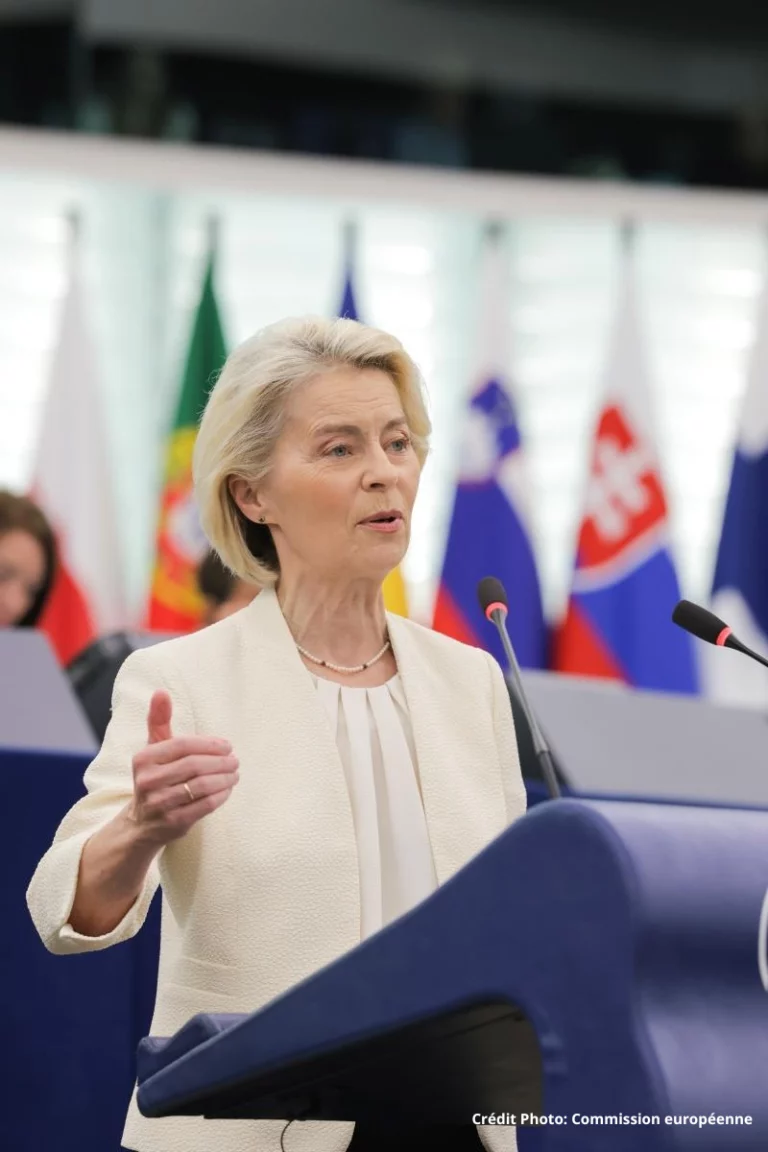
On 16 September 2026, Ursula von der Leyen delivered his sixth speech on the state of the European Union (SOTEU) before the European Parliament in Strasbourg on the occasion of the European Parliament. Since Treaty of Lisbon, this annual meeting allows the president of the European Commission present the Union's broad guidelines for the coming year and discuss with MEPs.
This edition comes in a particularly tense geopolitical context: war in Ukraine, conflict in the Middle East, trade tensions with China, more uncertain transatlantic relations with the United States and increased hybrid threats. Politically, the Union also faces increasing polarisation and the growth of extreme right-wing and Eurosceptic forces in several Member States. The disinformation and foreign interference, as well as questioning certain democratic values, are thus presented as major challenges.
Faced with these developments, Ursula von der Leyen defends the idea of a stronger, more independent and more able Europe to act on its own. The SOTEU 2026 draw thus several European priorities for 2026, on competitiveness and employment, the social dimension and inclusion, security and defence, climate and resilience and finally the rule of law, democracy and values.
SOTEU 2026: Strengthening European competitiveness
The European competitiveness the European economy is presented as the first priority. In order to reduce obstacles to enterprise development, the Commission intends to complete the recasting of the Single European Marketspeed up authorisation procedures and further administrative simplification.
Several measures are announced, including a banking and financial simplification package, a transport simplification package and a strategy for diversifying supplies. The Commission is also planning the creation of a European Critical Raw Materials Corporation to secure access to critical raw materials for European industries.
These guidelines should help to strengthen the European Economic Security and to limit the dependence which could weaken the Union's businesses and strategic sectors.
Accelerating energy independence
Energy is directly related to the European sovereignty andEuropean energy autonomy. Ursula von der Leyen wants to double the share of electricity in the European energy mix by 2040, relying in particular on renewable energy, nuclear and other sources produced in Europe.
To achieve this, the EU is planning an action plan on electricity grids, with more investment in infrastructure, faster connections and storage development.
The objective is twofold: to reduce emissions and reduce European dependence on fossil fuel imports. This approach is also part of a desire to strengthen thestrategic independence of Europe.
Relaying down for Chinese competition
Ursula von der Leyen also stressed the need to reduce certain economic dependence on China. In particular, it proposes to diversify supply chains, strengthen strategic reserves and improve access to critical raw materials.
The Commission therefore wishes to avoid economic dependency becoming strategic vulnerabilities for the Union. Reduction of European Union strategic dependencies This is an important issue of European economic and industrial policy.
Adapting Europe to climate change
After a summer marked by heavy heat waves, fires and droughts, the Commission wants to strengthen the capacity of the EU toadaptation to climate change the Union and develop the climate resilience European territories.
Several initiatives are announced: a climate resilience framework for the most vulnerable territories, an alliance for climate risk insurance, a European heat wave plan and a new European water initiative. The objective is to better anticipate the consequences of climate change and to strengthen the protection of people and territories.
These measures thus contribute to the climate and European resiliencestrengthening the Union's capacity to deal with the consequences of extreme climate events.
Framework and develop artificial intelligence
The AIA is presented both as an economic opportunity and as a security issue. The Union wishes to continue implementing the European regulation on artificial intelligenceWhile strengthening cooperation with partners such as Canada and the United Kingdom on model evaluation and safety.
The Commission is also planning a massive increase in European computing capacity and to facilitate public and private investment in enterprises specialising in computing.European artificial intelligence.
Particular attention will be paid to the use of AI in five sectors: health, transport, agri-food, advanced industry, defence and space. New initiatives are to be presented in November.
The aim is to enable Europe to develop its own technological capabilities while ensuring a common framework for the development and use of artificial intelligence.
Protecting young people in the digital space
Digital transformation also raises challenges for Protection of Children and Adolescents. Ursula von der Leyen announced the EU KIDS ACTincluding The ban on social networks for children under 13 and the prohibition of opening a personal account before 15 years. Between the ages of 13 and 15, young people could have accounts with limited functionality and supervised by their parents. The Commission also plans to Digital Fairness Act, designed to enhance the protection of users from digital practices designed to capture their attention. The aim is to build a safer and more age-friendly digital environment.
Strengthening social Europe
In the face of changes in the labour market, in particular related to AI, the Commission plans to introduce legislation on quality jobs by the end of the year, focusing on job quality and skills.
It also announces a European Pact for Care, designed to address the challenges of an ageing population, as well as measures on the affordable housing in Europe.
The European Pact for Care In particular, it must accompany demographic changes and the growing need for care. The European Social Rights Base, which will celebrate its 10th anniversary in 2027, remains a frame of reference for these policies.
Building new partnerships
In an international context marked by uncertainties about relations with the United States, Ursula von der Leyen wishes to diversify and deepen the Union's partnerships. This strategy should help to strengthen thestrategic independence of Europe and its ability to act in a more uncertain international environment.
Canada has a special place in this strategy. Canadian Prime Minister Mark Carney was present in the European Parliament during the speech. Ursula von der Leyen proposed to build a « Alliance for the Future » around technology, energy, critical raw materials, batteries, AI, quantum, cybersecurity and the Arctic.
It also proposed opening the way for a first « Associate member » European Union for Canada.
Strengthening European security and supporting Ukraine
The Security and European Union defence are one of the major axes of the discourse. The Commission plans to present a new European security strategy and wishes to establish a European Security Council to strengthen coordination between Member States.
It also announces a new European instrument on strategic capabilities, based on theArticle 4, in order to strengthen the Union's common capacity.
On Ukraine, Ursula von der Leyen reaffirmed the support for Ukraine, in particular for energy supply and air defence, as well as the desire to strengthen the European sanctions against Russia.
The war in Ukraine thus remains a central element of European security policy and reflection on the future of the European Union.
Near East and migration
On the Middle East, Ursula von der Leyen announced financial support for reconstruction and the Palestinian Authority, while reaffirming the prospect of a two-State solution.
In the field of migration and the European UnionThe Commission wishes to further strengthen Frontex's external borders and capabilities, while further developing opportunities for regular migration and job integration. A new European emergency response framework will also be put in place to better respond to situations of exceptional or large-scale migratory movements.
These guidelines are part of European work to strengthen border management and to further organise legal routes to European territory.
Protecting democracy and the rule of law
Finally, the speech gives an important place to the European democracy. In the face of misinformation, foreign interference and political polarisation, the Commission wishes to strengthen the mechanisms for the protection of democracies.
The fight against disinformation and foreign interference This is a growing challenge for the European institutions, particularly in a context of increasing hybrid threats.
LRule of law in the European Union It also remains an essential condition for the enlargement of the European Union. The Commission intends to continue the reforms undertaken with the candidate countries and to stress that respect for European values is a prerequisite for their rapprochement with the EU. The European Commission also intends to propose a « Congress of Europe ».
To be retained
SOTEU 2026 draws up a strategy around the same objective: to strengthen the Union's capacity to act in an increasingly uncertain geopolitical and political environment. Competitiveness, energy independence, artificial intelligence, climate adaptation, social rights, defence, international partnerships and the protection of democracy are the main priorities announced for the coming years.
Your opinion counts! Share your views by responding to the European Commission survey via this link: here
1)Who delivers the annual speech on the state of the European Union?
It is the President of the European Commission. By 2026 it was Ursula von der Leyen. She was the first woman to be elected President of the European Commission in 2019, and re-elected for a second five-year term by the European Parliament in 2024.
2) Who is Mark Carney?
Mark Carney has been the Prime Minister of Canada since March 14, 2025 (as Justin Trudeau's successor). He was present in the European Parliament as part of the strengthening of strategic relations between the European Union and Canada, particularly in the areas of trade, security and defence.
3)What are the five main priorities of the European Commission for the year 2026?
The five main priorities for the year are competitiveness and employment, the social dimension and inclusion, security and defence, climate and resilience and finally the rule of law, democracy and values.

