
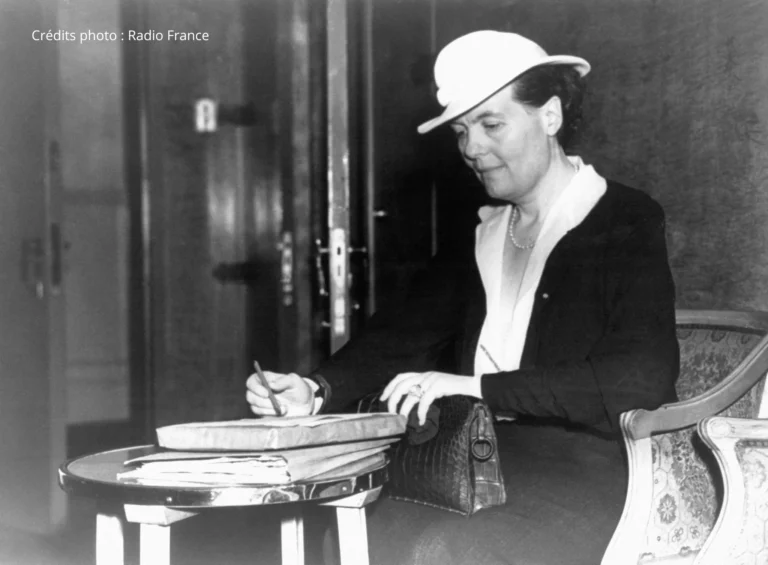
When it comes to European integration, the names of Robert SchumanJean Monnet, Alcide de Gasperi and Konrad Adenauer are often highlighted. Yet many women have also helped shape the European project. Resistant, journalists, activists or politicians, forgotten women in European integration are great figures of Europe, committed to peace, democracy and cooperation among peoples. These women who have built Europe helped to broaden the priorities of the European project to include fundamental rights, culture and equality between citizens.
Women committed to peace and a united Europe after the Second World War
In the aftermath of the Second World War, a new ambition emerged: to build a united Europe capable of preserving lasting peace.
Louise Weiss, a voice for peace and European unity
From the 1920s, the journalist and politician Louise Weiss, nicknamed « the grandmother of Europe », defends the rapprochement between the peoples of Europe. Through its articles, it supports a Europe capable of promoting democracy and humanistic values. She was also campaigning for women's right to vote, convinced that democracy required the full participation of citizens.
During the Second World War, she joined the French Resistance and helped rescue Jewish children persecuted by the Nazi regime. After the war, it continued its commitment to a united Europe. In 1979 she was elected to the European Parliament in the first direct universal suffrage elections and delivered the inaugural speech of the new assembly. His journey illustrates the role of women and European values in the construction of a joint project.
Ursula Hirschmann, a pioneer of European federalism
Opposed to Nazism in the 1930s, Ursula Hirschmann engages in anti-fascist resistance in Italy. It plays an essential role in the clandestine dissemination of the Ventotene Manifesto (1941), a founding text calling for the construction of a federal Europe in order to avoid the recurrence of conflicts.
After the war, she continued her commitment to European federalism and helped spread the European Federalist Movement. In 1975, she founded the Women for Europe Association to encourage greater participation of women in the European project. His journey illustrates the link between Women and European Federalism and the importance ofWomen's involvement in the European project.
The first women at the heart of European institutions
The first decades of European integration also see the emergence of women who are gradually investing in institutions. These first women in the European institutions contribute to giving a more social and civic dimension to the European project.
Marga Klompé, a pioneer of the European institutions
Scientist and teacher, Marga Klompé engages in Dutch resistance during the Second World War. Elected to the Dutch Parliament in 1948, she participated in the work related to the United Nations Universal Declaration of Human Rights.
In 1952, she became the first woman to sit on the Joint Assembly of the European Coal and Steel Community (ECSC). It thus participates in the initial work of the women in the European institutions. In 1956 she became the first woman minister in the Netherlands and defended a Europe that was attentive to solidarity and social protection.
Simone Veil, a major figure in the European Parliament
Recaptured from the Holocaust, Simone Veil European reconciliation is the key to its political commitment. Elected MEP in 1979, she became the first female president of the European Parliament elected by direct universal suffrage.
Its action contributes to strengthening the democratic legitimacy of the European Parliament and bringing citizens closer to the institutions. It embodies a major step in the representation of women in European politics and remains one of the most emblematic personalities in the history of European integration.
Women who have expanded Europe's priorities: culture, rights and equality
European integration has not been limited to economic issues. Some women have also helped to broaden the European project towards culture, human rights and equality.
Melina Mercouri, culture as a European dimension
Actress recognized then Greek Minister of Culture, Melina Mercouri became a political figure after his opposition to the colonels' dictatorship. It argues that culture is an essential element of European identity.
In 1983, during the first Greek Presidency of the Council of the European Communities, it brought together European Ministers of Culture. Its commitment leads in particular to the creation of European Capitals of Culture in 1985, which still value the cultural diversity of the continent.
Anna Lindh, a European voice for peace and human rights
Swedish Minister for Foreign Affairs from 1998, Anna Lindh embodies a Europe committed to peace, human rights and international dialogue. It defends a foreign policy based on respect for international law and the protection of democratic values.
In 2001, during the Swedish Presidency of the European Union, it played an important role in managing the crisis in the Republic of Macedonia, helping to bring European actors closer together around a common position. His journey illustrates the ambition of a European Union capable of bringing a collective voice to the international stage.
The legacy of these pioneers: towards a more equal Europe
These routes show thatEuropean women's history is fully linked to the development of the European project. Through their commitments to peace, democracy, culture or human rights, these women have helped to define the values that today shape the European Union. Long told mainly through the « founding fathers »European history now recognizes the contribution of these pioneers.
Their legacy reminds us that European integration is also a history of citizen participation, political commitment and the defence of equality. Today, Equality between women and men is an essential value of the European Union, which acts in particular to promote professional equality, combat violence against women and improve women's representation in decision-making spaces.
Why are we talking about « founding fathers » European Union?
Figures such as Robert Schuman, Jean Monnet and Konrad Adenauer played a key role in the early stages of European integration. However, many women have also contributed to the European project, defending peace, democracy, fundamental rights and culture. Their role is now further highlighted by European historians and institutions.
Is equality between women and men a value of the European Union?
Yes. Equality between women and men is enshrined in the EU Treaties and in the EU Charter of Fundamental Rights. The EU adopts laws, sets common objectives and supports Member States to promote equality in areas such as employment, combating violence against women and representation in decision-making bodies.
Who is the first woman to preside over the European Parliament?
Simone Veil became the first woman to preside over the European Parliament in 1979, following the first European elections by direct universal suffrage. Recaptured from the Holocaust and a major figure in European reconciliation, it has worked to strengthen the role of Parliament in the institutions of the European Union.

