
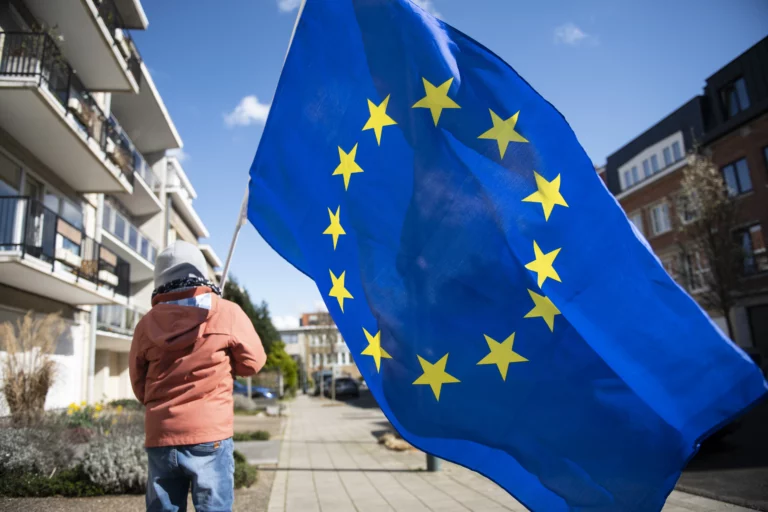
To become the one we know today, the EU has had to build itself, year after year, through the accessions of countries that become Member States; This is what we call the European integration. In order to ensure this, Europeans have had to agree on common bases: treaties and values of course, but also symbols, such as the EU flag, This is a unique project, given the importance and strength of collaboration between so many countries.
The European flag and its stars, the first symbol of an understanding between peoples
Today, an absolute symbol of the European Union, the official flag of the European Union was born from an institution older than the EU: the Council of Europecreated after World War II in 1949. In 1955, when choosing the flag that will become their symbol, the ministers selected the project of Arsène Heitz, a French official of the Council of Europe. Thus, the blue background adorned with twelve golden stars has become the image of a united Europe, which will become a 1985 the official flag of all European institutions and a pillar of the Union's visual identity.
Why are there 12 stars on the European flag?
That's the question that remains: why 12 stars?
This number does not represent the number of EU Member States (currently 27). Nor does it represent the number of EU founding countries, which were only 6 (Germany, France, Italy, the Netherlands, Belgium and Luxembourg).
The choice of the 12 stars is of less concrete importance, since the number 12 symbolically represents harmony and balance. This number embodies a perfect cycle: the 12 months of the year, the 12 signs of the zodiac, the 12 hours of day and night, the 12 works of Hercules... In addition, these 12 stars of the European flag allow the formation of a homogeneous and indivisible circle, symbol of union between peoples. It is therefore this invariable number of stars, symbol of perfection and fullness, which has been retained by European leaders.
The European anthem, a universal and unifying choice
Beyond its flag, the European Union has another equally important symbol: European anthem. However, the introduction of a European anthem induces some caution: how do you choose an anthem that will not give the impression of replacing national anthems? Fortunately, the leaders found the solution; in 1985, they chose a hymn without speechto celebrate the values shared by Member States.
To find its ideal anthem, Europe turned to classical music. After several proposals, it is finally "Ode to Joy" by Ludwig van Beethoven, who was chosen, without words. The last movement of the German composer's 9th symphony, composed in 1823, is in fact a musical presentation of a poem written in 1785 by Friedrich Schiller. This poem, which celebrates an ideal of unity and brotherhood among all human beingsis fully in line with the European project. Today, this anthem is played mainly at official ceremonies in which the EU participates, and more broadly in any event of a European nature.
Currency and "Europe Day", other EU founding symbols
Throughout its construction, the European Union continued its search for common references. Today, the European Union is essentially defined by four symbols: the flag, the anthem, the motto, and Europe Day.
In 1985, European leaders decided to set up a Day dedicated to Europe. Again, a symbolic date is chosen: May 9. This date commemorates the declaration of 9 May 1950 Robert Schuman (French Minister for Foreign Affairs), considered a founding text of our EU. Today, Europe Day is celebrated every year in all Member States, even during all of May in some countries such as France.
Finally, although the flag, Europe Day and the European anthem have been adopted for several decades, the motto is much more recent. Indeed, Europe's motto, "United in diversity" was first used in 2000. This motto characterizes how Europeans have come together by enriching all the cultures and traditions of the continent. It was also the result of a large competition launched in 1998 in schools in the 15 member countries, which mobilized more than 80,000 young people. Finally, it was the proposal of a Luxembourg class, "United in diversity", which was accepted and translated into all official languages Member States of the Union.
Thus, whether it be through a motto, a day, an anthem or a flag, the values conveyed by the European Union remain the same. Solidarity, equality, tolerance and the spirit of democracy are and will remain the ideals that have led the Member States to unite and to represent their Union by common symbols.
Beyond the symbols, what are the elements that form the basis of the European Union?
The European Union is built primarily on treaties, which established the framework for union between the peoples of Europe. It is also based on common values, and was designed by "founders" such as Robert Schuman.
For more information, please see the tab European Union fundamentals.
What does Robert Schuman's 1950 declaration say, which is considered the EU's founding text?
After the Second World War, Robert Schuman's declaration called on several European countries, including France and Germany, to reconcile their economic interests through the creation of the European Coal and Steel Community (ECSC). This new institution lays the foundations of the EU as we know it today.
« Europe will not be done at once, nor will it be built together: it will be achieved through concrete achievements that will first create de facto solidarity » (Robert Schuman, 9 May 1950).

